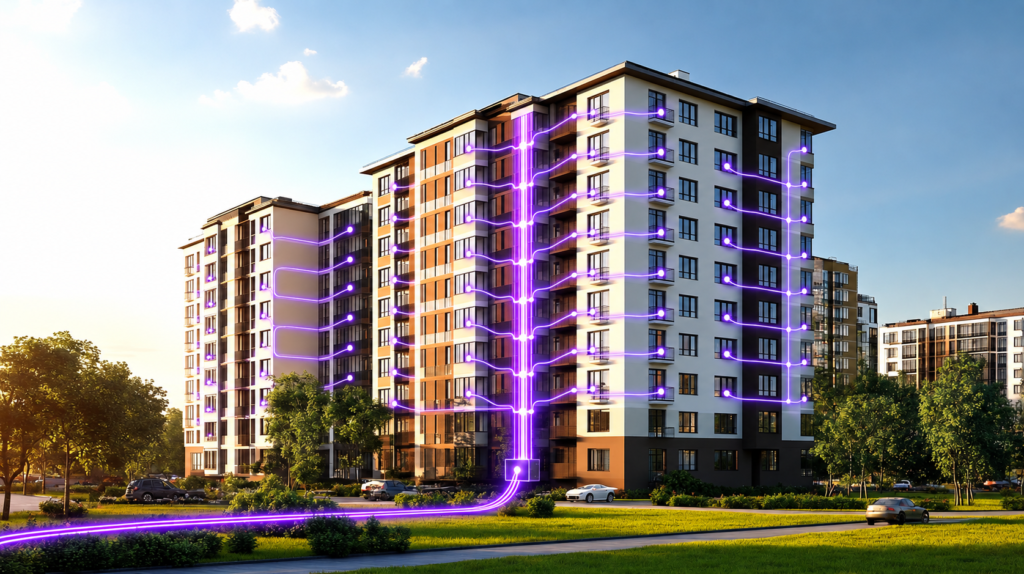
Most Slow-WiFi Complaints Don’t Start at the Router
When residents complain about slow or unreliable Wi-Fi, the instinct is often to look at the router. Reset it. Replace it. Upgrade the access points in the hallway. Those steps can help when the issue is wireless coverage, interference, or equipment capacity. But if slowdowns affect many units at once, the bottleneck may be farther upstream: in the building’s internet service, distribution network, or backbone connection.
For property teams evaluating service providers or planning infrastructure improvements, understanding the connection between the building backbone and in-unit Wi-Fi can help separate a coverage problem from a capacity problem. Both deserve attention, but they require different fixes. For teams comparing options, fiber vs coax internet for apartment buildings is a useful starting point, but it should be assessed alongside the property’s internal wiring and wireless design.
A Short History of How Coax Became the Default
Coaxial cable became common in residential properties because it was widely installed for cable television. Cable providers later developed technologies such as DOCSIS to deliver broadband internet over the same physical medium. Modern coax networks can provide high download speeds, although performance depends on the generation of equipment, service plan, shared capacity, and condition of the outside plant and in-building wiring.

Built for Cable TV, Stretched to Carry Data
That evolution supported the move from simple email and web browsing to video calls, streaming, cloud services, gaming, and smart-home devices. In an apartment building, performance can still deteriorate when a shared network segment becomes congested or aging wiring introduces signal problems. Evening slowdowns affecting multiple units are one sign that property teams should investigate network capacity, but they are not proof that the coax cable alone is at fault. For any property considering an upgrade, fiber vs coax internet for apartment buildings should be evaluated in the context of actual resident demand and the condition of in-building cabling.
Many traditional cable-internet plans also offer substantially more download speed than upload speed. This can matter for residents who rely on video conferencing, large cloud uploads, or remote work. However, not every coax deployment is the same: newer DOCSIS architectures can improve upstream capacity, and actual speeds depend on the provider’s network and plan.
What Changes With a Fiber-Optic Backbone
A fiber-optic backbone carries data over light rather than electrical signals, making it highly resistant to electromagnetic interference and well suited to high-capacity connections. One common architecture is XGS-PON, a passive optical networking standard with a nominal 10 Gbps capacity in each direction at the PON level. That capacity is shared among the customers served by a given PON port, so the service each resident experiences still depends on the network design, subscribed speed tier, equipment, and concurrent use. This is why XGS-PON multifamily internet is frequently considered for apartment communities planning long-term network upgrades.
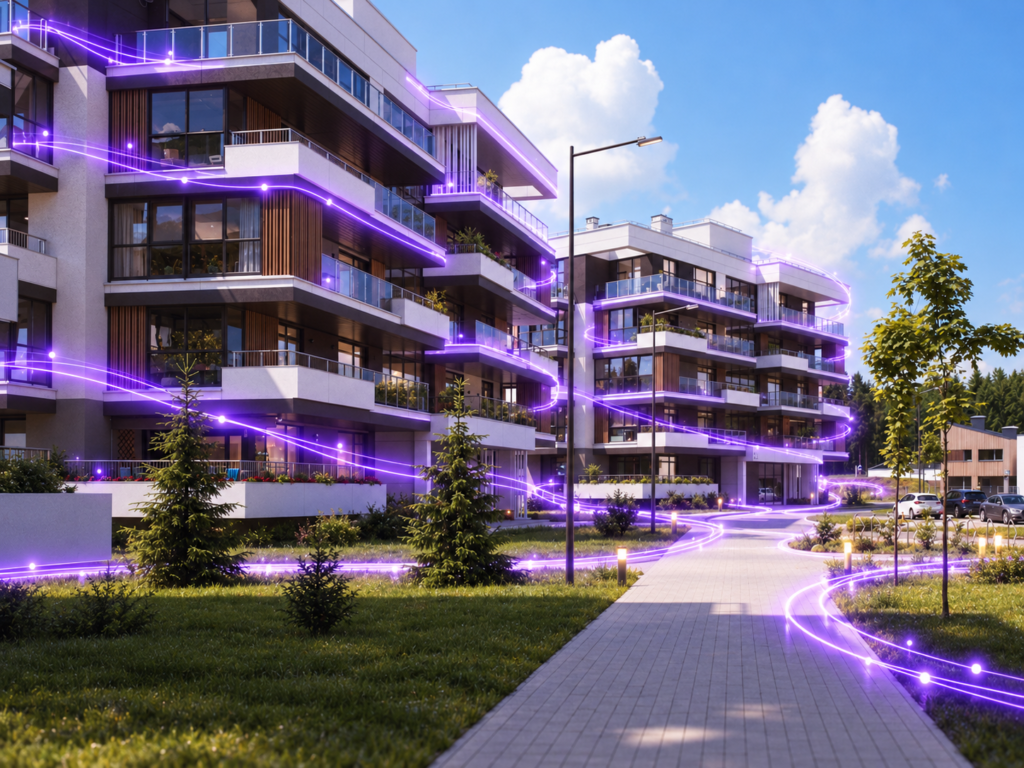
Symmetrical Speed Options and More Headroom for Demand
Properly provisioned fiber networks can support symmetrical residential speed tiers, an advantage for people who upload as much as they download. A resident attending a video call while another streams in 4K can enjoy a better experience when sufficient capacity is available. Fiber is not congestion-proof, however: bandwidth is still shared at points in the network, and the provider must engineer adequate capacity for peak demand. Search interest in symmetrical gigabit internet apartment solutions reflects a practical need: strong uploads for working, studying, and sharing files.
Lower Latency, Higher Reliability at Scale
Fiber cabling is less susceptible to electrical interference than copper cabling and can support long distances at high capacity. That is valuable in large residential properties, but low latency and reliable in-unit Wi-Fi also depend on routing, upstream connectivity, cabling inside the property, access-point placement, and device conditions. A well-engineered fiber network can reduce infrastructure-related limitations; it cannot, by itself, fix every wireless coverage issue.
The Question That Actually Diagnoses the Problem
When residents repeatedly report connectivity problems, asking only ‘How fast is the Wi-Fi?’ is not enough. A more useful evaluation includes: What type of service feeds the property? Where is capacity shared? What wiring connects each unit? When was that infrastructure last inspected or upgraded? And how is wireless coverage managed? These questions help distinguish a weak signal from an overloaded connection or a deteriorating cable run.
Older buildings may have undergone several router replacements while retaining the same distribution wiring. If problems recur, a structured assessment can identify whether the limitation is the Wi-Fi system, damaged cabling, network congestion, or another part of the service path. Replacing the backbone may be the right solution in some properties, but it should follow a diagnosis rather than be assumed to be the only answer. When reviewing aging cable infrastructure in multifamily properties, the goal is to identify actual bottlenecks rather than assume the oldest cable is always the cause.
What This Means for Long-Term Capital Planning
For owners, developers, and property decision-makers, network upgrades are capital-planning decisions with consequences beyond the initial installation. Comparing fiber and coax infrastructure means evaluating current speeds, upload needs, wiring condition, expansion potential, installation disruption, operating support, and total cost of ownership. A fiber backbone can provide valuable long-term capacity and upgrade flexibility, but the business case should be matched to the property’s actual infrastructure and resident needs. For owners comparing backbone infrastructure property internet investments, that assessment also supports realistic budgeting and upgrade priorities. A practical review of fiber vs coax internet for apartment buildings should also account for installation timelines, support responsibilities, and future capacity requirements.
Key Takeaways
- Coaxial networks can deliver fast broadband, but performance varies with DOCSIS technology, network design, shared capacity, and cable condition.
- Fiber and XGS-PON can support high-capacity, symmetrical service tiers; XGS-PON bandwidth is still shared, so sound provisioning matters.
- Repeated Wi-Fi complaints do not automatically mean the backbone is at fault; assess coverage, wiring, equipment, congestion, and upstream service.
- Ask when the building network was last assessed, how units are connected, where bottlenecks occur, and what upgrades are planned.
- The strongest infrastructure investment is the one informed by a property-specific assessment and a long-term capacity plan.
Find Out Whether Your Building Needs a Network Upgrade
Celerity Fiber focuses on fiber connectivity for multifamily properties. A building-level network assessment can help property teams understand the current infrastructure, identify capacity or coverage limitations, and compare options for a more reliable resident experience. Confirm available technology, service tiers, and deployment details with the Celerity Fiber team for your property.
Request a network assessment to understand whether your residents’ connectivity complaints originate in Wi-Fi coverage, in-building wiring, or the backbone—and what improvements would make the greatest difference.